'/%3e%3crect%20x='-83'%20y='270'%20width='356'%20height='136'%20fill='%23FF6600'/%3e%3cpath%20d='M564%20260Q616%20260%20648.5%20277.0Q681%20294%20697.5%20311.5Q714%20329%20716%20333H724V270H895V800H724V737H716Q714%20741%20697.5%20759.0Q681%20777%20648.5%20793.5Q616%20810%20564%20810Q506%20810%20463.0%20786.5Q420%20763%20391.0%20723.5Q362%20684%20348.0%20635.0Q334%20586%20334%20535Q334%20484%20348.0%20435.0Q362%20386%20391.0%20346.5Q420%20307%20463.0%20283.5Q506%20260%20564%20260ZM618%20397Q581%20397%20556.0%20417.5Q531%20438%20519.0%20469.5Q507%20501%20507%20535Q507%20569%20519.0%20600.5Q531%20632%20556.0%20652.5Q581%20673%20618%20673Q655%20673%20679.5%20652.5Q704%20632%20716.5%20600.5Q729%20569%20729%20535Q729%20501%20716.5%20469.5Q704%20438%20679.5%20417.5Q655%20397%20618%20397Z'%20fill='%23FFFFFF'/%3e%3cpath%20d='M1329%20810Q1278%20810%201245.0%20793.0Q1212%20776%201196.0%20758.5Q1180%20741%201178%20737H1170V800H999V40H1170V333H1178Q1180%20329%201196.0%20311.0Q1212%20293%201245.0%20276.5Q1278%20260%201329%20260Q1388%20260%201431.0%20283.5Q1474%20307%201502.5%20346.5Q1531%20386%201545.5%20435.0Q1560%20484%201560%20535Q1560%20586%201545.5%20635.0Q1531%20684%201502.5%20723.5Q1474%20763%201431.0%20786.5Q1388%20810%201329%20810ZM1276%20673Q1313%20673%201338.0%20652.5Q1363%20632%201375.0%20600.5Q1387%20569%201387%20535Q1387%20501%201375.0%20469.5Q1363%20438%201338.0%20417.5Q1313%20397%201276%20397Q1239%20397%201214.0%20417.5Q1189%20438%201177.0%20469.5Q1165%20501%201165%20535Q1165%20569%201177.0%20600.5Q1189%20632%201214.0%20652.5Q1239%20673%201276%20673Z'%20fill='%23FFFFFF'/%3e%3cpath%20d='M1664%20800V270H1835V800Z'%20fill='%23FFFFFF'/%3e%3crect%20x='1664.0'%20y='40'%20width='171'%20height='171'%20fill='%23FF6600'/%3e%3cpath%20d='M1945%20800V270H2116V345H2121Q2131%20329%202148.5%20309.0Q2166%20289%202195.5%20274.5Q2225%20260%202269%20260Q2333%20260%202371.5%20289.0Q2410%20318%202427.0%20362.5Q2444%20407%202444%20454V800H2273V486Q2273%20452%202255.0%20425.5Q2237%20399%202196%20399Q2151%20399%202133.5%20428.5Q2116%20458%202116%20493V800Z'%20fill='%23FFFFFF'/%3e%3cpath%20d='M2792%20810Q2724%20810%202684.5%20789.0Q2645%20768%202627.0%20736.5Q2609%20705%202604.0%20672.5Q2599%20640%202599%20617V406H2511V270H2599V139H2770V270H2878V406H2770V612Q2770%20642%202786.5%20659.5Q2803%20677%202843%20677Q2860%20677%202873.0%20674.5Q2886%20672%202886%20672V800Q2886%20800%202857.5%20805.0Q2829%20810%202792%20810Z'%20fill='%23FFFFFF'/%3e%3cpath%20d='M3236%20810Q3165%20810%203113.0%20786.5Q3061%20763%203026.5%20723.5Q2992%20684%202975.5%20635.0Q2959%20586%202959%20534Q2959%20484%202975.0%20435.0Q2991%20386%203024.0%20346.5Q3057%20307%203108.5%20283.5Q3160%20260%203231%20260Q3307%20260%203364.5%20292.5Q3422%20325%203454.5%20387.5Q3487%20450%203487%20539V579H3131Q3134%20620%203160.5%20650.5Q3187%20681%203236%20681Q3273%20681%203292.5%20667.5Q3312%20654%203319.0%20640.0Q3326%20626%203326%20626H3483Q3483%20626%203478.0%20644.5Q3473%20663%203459.0%20690.5Q3445%20718%203418.0%20745.5Q3391%20773%203346.5%20791.5Q3302%20810%203236%20810ZM3130%20480H3323Q3321%20433%203294.5%20409.0Q3268%20385%203228%20385Q3189%20385%203161.5%20409.0Q3134%20433%203130%20480Z'%20fill='%23FFFFFF'/%3e%3cpath%20d='M3585%20800V40H3756V800Z'%20fill='%23FFFFFF'/%3e%3c/svg%3e)
Sheet metal vs machining vs casting: choosing the process
Same part, three ways to make it, three very different bills. A plain map of where folded sheet wins, where you should machine from solid, and where casting earns its tooling.
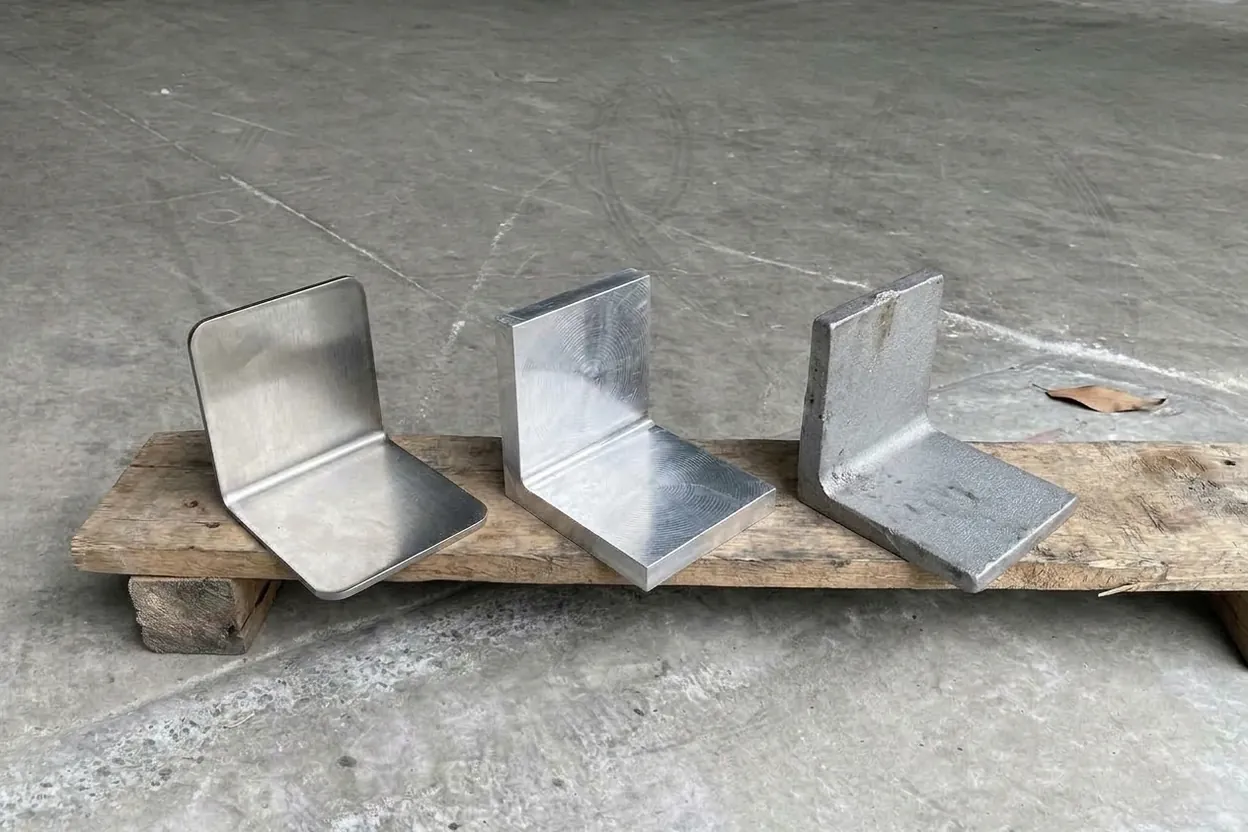
Three ways, three cost curves
Most metal parts can be made more than one way, and the "best" way is really the cheapest way that meets the spec. The three big families — folded sheet, machined-from-solid, and cast — have completely different cost curves. Pick against that curve and you either overpay for tooling you didn’t need or fight a process that was never suited to the part.
| PROCESS | BEST FOR | TOOLING | VOLUME |
|---|---|---|---|
| Folded sheet | Enclosures, brackets, panels | None | 1 – 10,000+ |
| Machined | Solid parts, tight tolerance | Low | 1 – 1,000s |
| Cast | Complex 3D shapes | High (mould) | 1,000s+ |
Rule of thumb: below a few thousand parts, tooling-free processes usually win on total cost.
Where folded sheet wins
If the part is essentially a shell — an enclosure, a bracket, a panel, a frame, a chassis — sheet metal is usually the answer. There’s no tooling to pay off, so part one is cheap; it’s light and strong for its weight because the bends do the stiffening; and it scales from a single prototype to a production run on the same machines. Cutting and folding is fast, which means lead times measured in days.
When to machine from solid
Some parts have to be solid: a block that takes a bearing, a face flat to a hundredth, a thread cut into real thickness, a feature no bend can make. That’s machining territory. It holds tolerances sheet metal can’t and needs no tooling, but you pay for the metal you cut away and the time to cut it — so it shines on small, precise, solid parts, not big hollow ones.
When casting earns its tooling
Casting makes complex three-dimensional shapes — organic curves, varying wall thickness, features in every direction — in one shot. But the mould costs real money up front, so it only pays back over thousands of parts. Below that, the same shape is usually cheaper as a folded-and-welded fabrication, even if it takes a few more pieces to get there.
“Casting spreads a big tooling bill over a huge run. If the run isn’t huge, you’re just paying the bill.”
Design and CAD/CAM programming at LASER Tuấn Thịnh.
All notes by Khang →Keep reading
All notes →Not sure sheet metal is the right call?
Send the part. If folded sheet is the wrong process for it we’ll tell you — and point you at the right one.